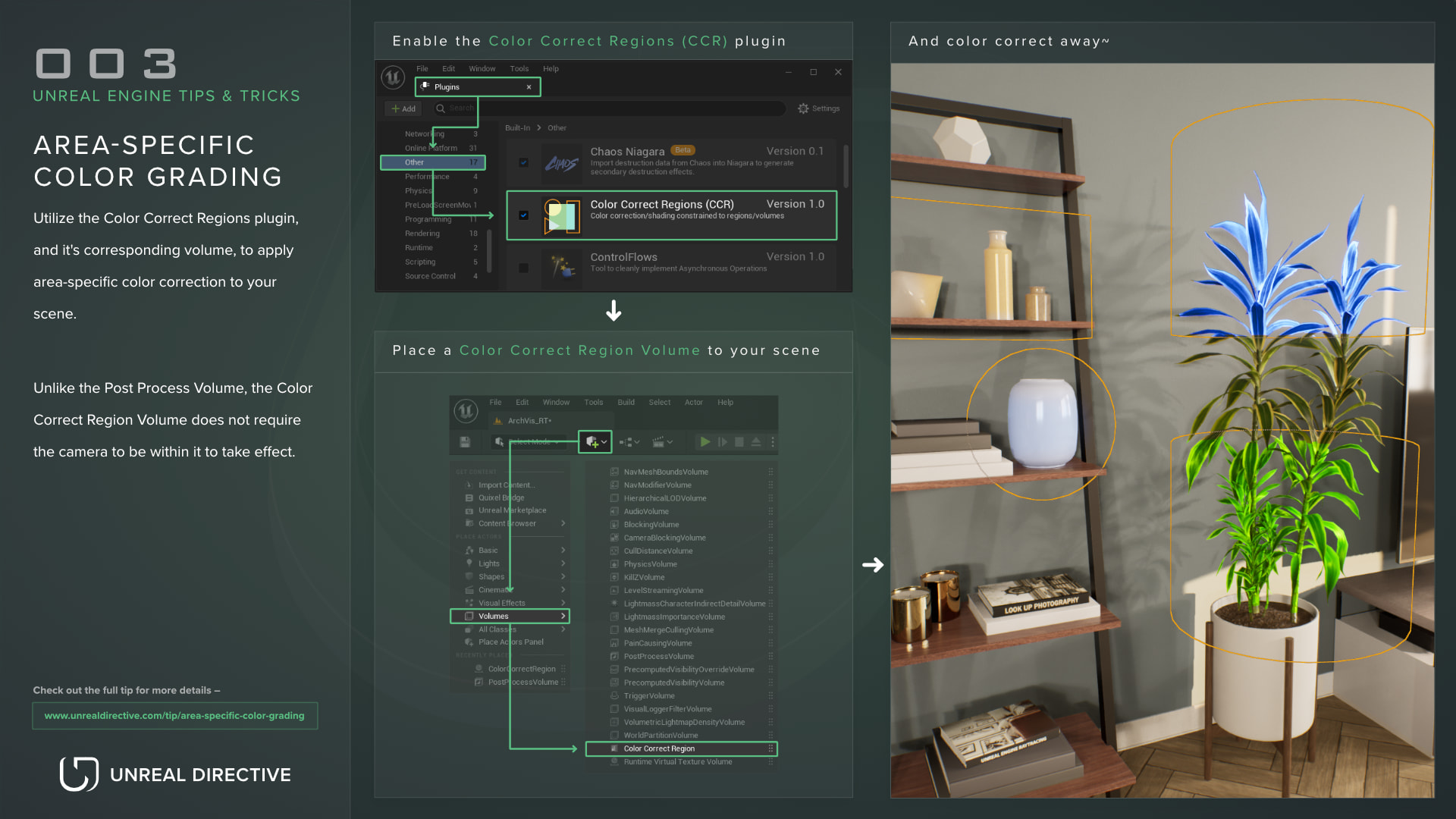
Utilize the Color Correction Regions plugin, and its corresponding actor, to apply area-specific color correction to your scene.
Unlike the Post Process Volume, the Color Correction Region does not require the camera to be within it to take effect.
Details
Color grading within Unreal Engine can prove to be quite tricky at times. Outside of the domain of adjusting lighting, materials, and the textures themselves -- you have the Post Process volume. This volume is a powerful tool for artists and designers to adjust the overall look and feel of the world.
However, there are two critical flaws with the Post Process volume that doesn't give artists and designers the creative freedom that they need.
The Post Process Volume Flaws
The first flaw is proximity. Outside of enabling infinite extent, the Post Process volume only takes effect when a camera or entity enters within the volume.
The second flaw is that the Post Process volume affects everything equally. Once the volume is entered, it'll adjust the whole visual scene.
The Color Correction Regions Plugin
Thankfully, there is a built-in solution that addresses both of these flaws. That solution is the Color Correction Regions plugin, CCR for short.
After enabling this plugin within the plugin browser, there will be a new option from within the Place Actors menu called Color Correction Region. This is a placeable actor with many adjustable color grading properties, similar to the Post Process Volume, but it'll only apply that color grading to what's within its bounds.
The Color Correction Region's bounds can be adjusted based on scale, shape, falloff, intensity, and many other unique options. This provides artists and designers the means to truly fine-tune the world to meet their vision.
Notes
- Do not overuse this feature as having a lot of these in your scene can prove to be quite costly performance wise.
- It's ideal to not use color grading to fix any exposure, lighting, or texture-related issues. Instead, aim to solve those within their own domain.
- The example scene used was the Archviz Interior Sample from Epic Games.
Detail Panel Settings
| Setting | Description |
|---|
| Type | The shape of the region. Choose between Sphere, Box, Cylinder, or Cone. |
| Priority | The priority level of the region. The higher number, the higher the priority. |
| Intensity | How much the region affects the world on a 0 to 1 scale. 1 being at full intensity. |
| Inner | Adjusts the inner falloff amount. |
| Outer | Adjusts the outer falloff amount. |
| Falloff | Adjusts the overall falloff amount. |
| Invert | Enable to have the region affect everything except what's in its bounds. |
| Temperature Type | The type of temperature to adjust. |
| Temperature | Adjust the color temperature, similar to light temperature settings. |
| Tint | Tints the color correction, alongside Temperature. |
| Color Grading Settings | The same color grading settings found in the Post Process Volume. Saturation, Contrast, Gamma, Gain, and offset options for Global, Shadows, Midtones, and Highlights. Along with ShadowMax, HighlightsMin, and HighlightsMax. |
| Enable Color Grading | Enable or disable the region's color correction. |
| Enable Per-Actor CC | Enable per-actor color correction using mesh stencils. |
| Per-Actor CC Mode | Choose whether to Exclude Selected Actors or Affect Only Selected Actors. |
| Actor Selection | The list of actors affected by the per-actor color correction. |
Links